Selective product incentive schemes pay MRs on four brands.
October 27, 2026
Pulkit Agarwal
Pulkit Agarwal
Key Insights
Pharmarack found new products added 2.1 points of India's 2025 pharma growth.
In this blog:
Where pharma growth comes from now
What the scheme is, and why effort follows pay
Weights, gates, slabs and brand floors
How the MR sees which brands move the payout
When I sit with pharma sales heads, the brand list comes up early. A division carries a long bag. The growth plan rests on a few brands. The MR has a few minutes per doctor.
A plan that pays on every brand leaves the choice to the MR. A plan that pays on four brands makes the choice. That works when other brands sit in a basket. Each focus brand also needs a floor.
The scheme has to be readable too. An MR who sees a short brand on day 15 can act. At month end, it is too late.
A question worth asking the head of sales operations this week: can every MR see their short brand today?
Table Of Content
Where pharma growth comes from now
India's pharma market is growing again. Price and new brands carry much of that growth.
Pharmarack sized the market at ₹2,40,672 crore in 2025. Value grew 8.1% that year. Pharmarack also split growth for the period to November 2025. Total growth was about 8%. Price added 5.4 points. New products added 2.1 points. Volume added 0.5%.
The pace has picked up in 2026. Pharmarack reported September 2026 value growth close to 13.5%. Volume grew about 3.4%. Cardiac volume grew about 9.1%.
Hindustan Times puts India's pharma field force at about six lakh. Each MR carries a bag of brands. The incentive plan decides which brands reach the doctor.
Sources: Pharmarack Indian Pharma Industry Performance report, January 2026, as reported by ANI in The Tribune, full year 2025 and the period to November 2025 · Pharmarack data for September 2026, reported by BioSpectrum India, 15 October 2026 · Hindustan Times, field force estimate · monthly growth swings, so read one month with care
New products added 2.1 points of growth in 2025, so the brand list matters.
What a selective product incentive scheme is
A selective product incentive scheme pays on a few focus brands. The list changes each cycle. The other brands still count. They carry a smaller weight or a basket target.
Take an illustrative division with 24 brands. Two are new launches. Four carry the year's growth plan. The other 18 are steady sellers.
A plan that pays equally on all 24 brands spreads the ask. The MR then pushes what is easy to sell. Focus brands compete with steady sellers for the doctor's time.
Plans with several measures are common. WorldatWork and SalesGlobe surveyed sales incentive professionals in 2021. They found 57% of companies use three or more measures. The report reads this as a move toward more specific results.
Source: WorldatWork and SalesGlobe, Sales Compensation Programs and Practices, 2021 · 472 sales incentive professionals, 397 answered the measures question, fielded June 2021 · a cross-industry sample, mostly outside India
A selective product incentive scheme names the brands the company needs this cycle.
Why effort follows what the plan pays
One field study from Indian pharma shows how MRs respond to plan design.
Four researchers studied an Indian pharma firm over three years. They were Sunil Kishore, Raghunath Rao, Om Narasimhan and George John. The firm switched reps from a quota bonus to a commission. The commission paid on sales above target. After the switch, sales rose 24%. Sales in the bottom quarter of performers rose 37%.
The study also found a cost. Under the commission, reps neglected unpaid tasks more. Effort moved toward what was rewarded.
That cuts both ways for a brand portfolio. Paying on 24 brands spreads effort thin. Paying on four brands moves effort to them. It can also starve the brands left out.
So the design question has two halves. Which brands carry the weight this cycle? What keeps the rest of the bag alive?
Source: Kishore, Rao, Narasimhan and John, Bonuses versus Commissions: A Field Study, Journal of Marketing Research 50(3), 2013 · one Indian pharma firm, 458 territories, about 14,000 monthly observations over three years · a natural experiment at one firm, and the switch changed the plan type rather than the brand mix
MRs put effort where the plan pays, so the brand list sets the field's time.
Weights, gates and slabs for focus brands
A working scheme has four parts. Each answers a different question.
Brand weights. These set how much each brand moves the payout. A launch brand may carry the top weight early.
A basket for the rest. Other brands share one basket target. A small weight keeps them in play.
Gates. Call average and doctor coverage open the payout. A gate qualifies the payout. It adds no rupees.
Slabs. Payout steps up at set achievement levels. Slabs can sit on each brand or on a weighted total.
Illustrative quarterly scheme for a 24-brand division
Component
Weight or rule
Purpose
Focus brand A, new launch
35%
Build prescriptions early
Focus brand B, cardiac
25%
Carry the growth plan
Focus brand C
15%
Defend share
Focus brand D
10%
Lift a lagging brand
Basket of 20 other brands
15%
Keep the bag in play
Call average gate
11 calls a day
Opens the payout
Doctor coverage gate
85% of list
Opens the payout
Brand floor
80% on each focus brand
Stops one brand carrying all
Slabs
90%, 100%, 110%, 120%
Step up the payout
The brand floor matters. Without it, brand B alone can carry the total. The launch brand then gets little time. An 80% floor keeps all four brands in play.
Keep every rule inside the plan. A product list held in a side sheet is itself a rule. When it drifts, payouts drift. That risk is covered in common commission calculation errors.
Model the weights before launch. Run the scheme on the previous quarter's actuals. Check how many MRs earn and what it costs. Then balance the mix across brands. Launch brands may need their own rules. Those are covered in new product launch incentives.
When to change the brand list
Change the list at the start of a cycle. A brand added mid-cycle resets the MR's month. A brand dropped mid-cycle can erase effort already spent.
Some changes cannot wait. A supply shortage may pull a brand. A price change may shift its target. Record each change as a dated version with a reason. Treat it as a mid-year incentive plan change, with notice to the field.
How finance reads the scheme
The CFO reads the same scheme as a cost line. Three readings help.
Cost by brand. What did each focus brand cost in payout this cycle?
Growth by brand. Did the brand grow faster than the basket?
Share earning. How many MRs earned on each brand?
A brand that costs more and grows no faster needs a new weight. A brand where few MRs earn may carry a target set too high. Read these numbers every cycle, before the next list is set.
Weights point effort, gates protect activity and floors keep every focus brand alive.
How the MR sees which brands move the payout
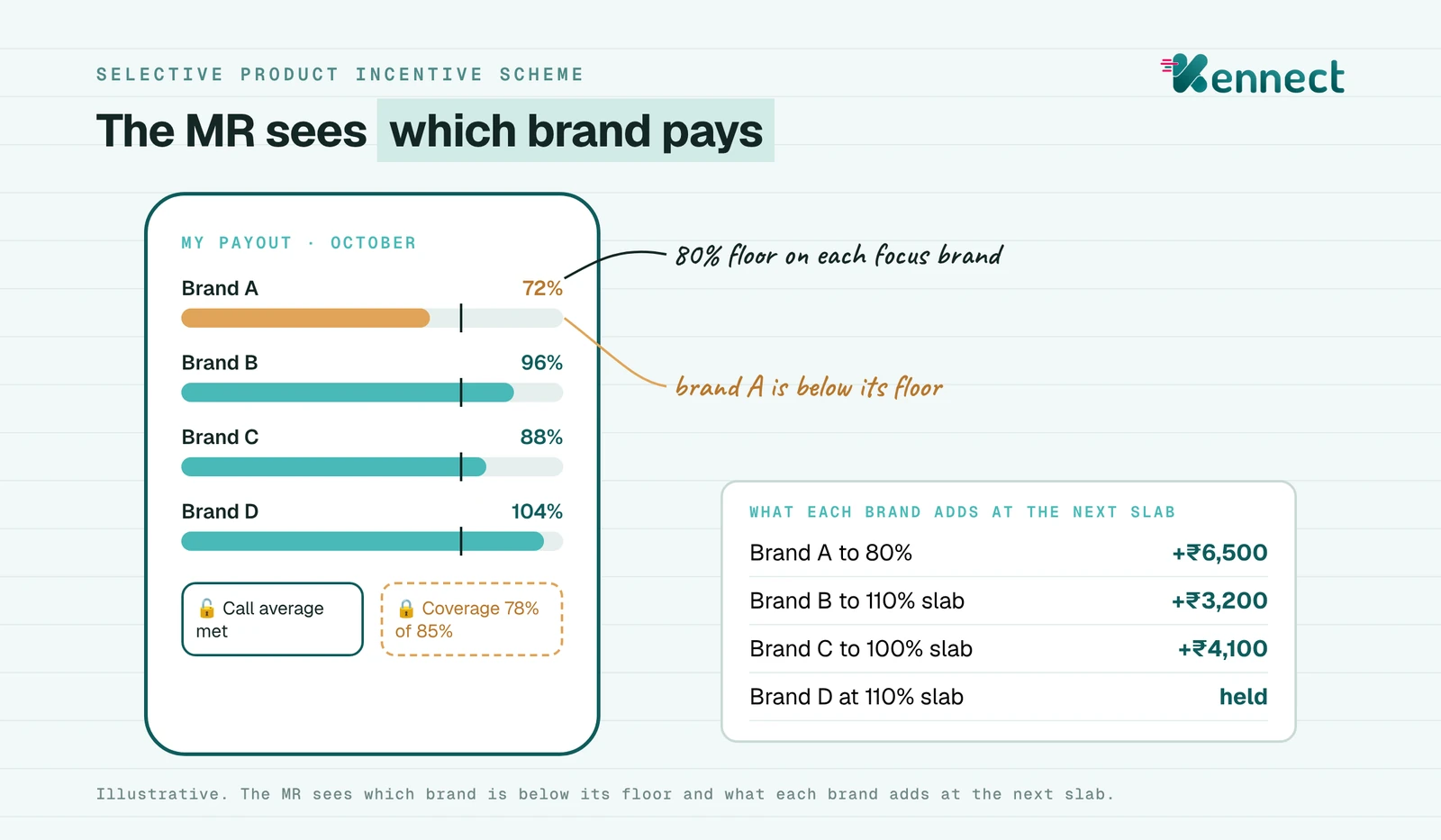
An MR cannot act on a scheme they cannot read. They need four facts on any day.
Achievement on each focus brand against target.
The rupees each brand adds at the next slab.
Where each gate stands.
Which brand sits below its floor.
Illustrative. The MR sees which brand is below its floor and what each brand adds at the next slab.
The levers an MR can pull are bounded. The Uniform Code for Pharmaceutical Marketing Practices 2024 sets the bounds. MRs must not use any inducement or subterfuge to gain an interview. Gifts for doctors are prohibited, and so are travel and hospitality unless the doctor attends as a speaker.
So pick focus brands an MR can sell through knowledge and calls. A weight beyond what a territory can absorb strains conduct. The Supreme Court's October 2026 order brings that link into view. We cover it in what the pharma marketing order means for MR incentives.
Source: KPMG India, Navigating the new regulatory terrain, March 2024, a summary of UCPMP 2024 as notified by the Department of Pharmaceuticals on 12 March 2024 · read the code text and take legal advice before changing a scheme
An MR who sees the short brand mid-cycle can fix it within the code.
How Kennect helps run selective product incentive schemes
Kennect runs incentives for more than 60,000 MRs in India. That is about 10% of the field force. More than ₹1,200 crore a year in incentives runs through it.
In these deployments, the focus brand list changes every cycle. So we build pharma sales force incentive management around that change.
Scheme designer and scheme modeling. Plan teams set weights, baskets, gates, floors and slabs as rules. They run a draft scheme on actual data. They see who earns and what it costs.
Dated plan versions. Each cycle's brand list is a dated version. An April payout traces to the April list. The audit trail and change log record every edit.
Data from systems you already run. Connectors bring in SFA calls and ERP sales. They also bring in secondary sales data. HR stays in the HRMS. Fill the white spaces, do not disrupt the foundation.
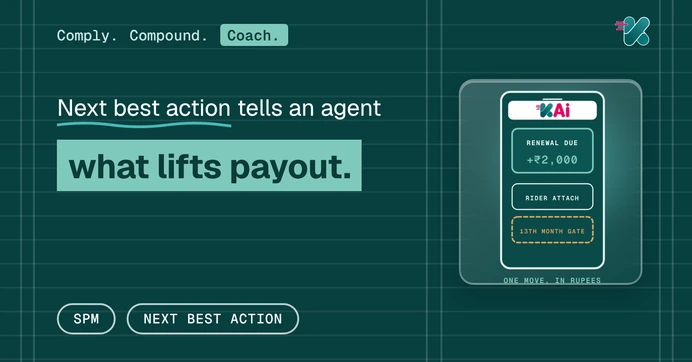
The MR's personal cockpit. Each MR sees achievement by brand and gate status. The slab view shows the next step. A what-if simulator shows what extra brand A sales earn. Kennect's AI-powered nudges flag a brand below its floor.
Kai, Kennect's AI: Kai writes each MR a plain-language earnings summary. The summary shows which focus brands moved the payout. It also names the brand holding it back. Admins use the AI KPI builder to define a brand-weighted KPI. They describe the KPI in a prompt. The AI plan builder, for whole plans, follows shortly.
One mid-sized Indian pharma deployment saw 80% fewer payout queries. The fall came once MRs could see how each payout was built.
Source: Kennect claim register · 60,000+ MRs and ₹1,200+ crore a year across India pharma deployments, about 10% of a 6,00,000 field force as reported by Hindustan Times · 80% fewer payout queries, one mid-sized Indian pharma deployment of 1,000+ MRs
When MRs see what each brand adds, the brand list moves prescriptions.
What this means for the April 2027 cycle
FY 2027-28 plans get designed between January and March 2027. Settle the focus brand list early. Set a floor on each brand. Put the rest in a basket. Show every MR, from day one, which brands move the payout.
Choose the brands in January, so MRs can sell them from April.
It is an MR incentive plan that pays on a few focus brands. The list changes each cycle. Each focus brand has a weight and a target. Other brands share a basket with a smaller weight. Gates such as call average decide whether the payout opens.
Many divisions use three to five. Match the number to the time an MR has per doctor. Model the scheme on the previous quarter's actuals first. Check how many MRs earn and what it costs. Check that no brand is left without effort.
Set a floor on each focus brand, such as 80% of target. Without a floor, a strong brand can carry the total. The launch brand then gets little time. Show each MR which brand sits below its floor during the cycle.
Many plans use them as gates. A gate decides whether the payout opens. It adds no rupees. This protects field activity without diluting brand weights. Set gate levels from territory data. Publish them with the plan.
Run the draft weights, floors and slabs on the previous quarter's data. Use actual sales and call data. Read the total payout and the share of MRs earning. Read the cost by brand against planned growth. Then approve a dated version.