SPM and ICM software differ in the decision each one supports.
July 25, 2022
Puneet Gupta
Puneet Gupta
Key Insights
Alexander Group's 2026 survey found about 65% of companies need stronger incentive governance.
In this blog:
What ICM software answers, and what sales performance management (SPM) adds
Which to buy first, by company stage and industry
The integration and audit questions a CIO should ask
Where AI changes each layer
CIOs and CFOs often ask me which to buy. My answer starts with a question back. Can you show every payout was right?
If not, start with the ICM core. Calculation, crediting, approvals and audit come first. Queries fall once reps see how a payout was built. Then add sales performance management (SPM). Targets, analytics and coaching show whether the plan moved sales.
In India the audit angle is real. Auditors report on internal financial controls under Section 143(3)(i). Payouts are part of that picture.
A question worth asking the CFO this week: can we trace our largest payout to its source?
Table Of Content
What the research says about running sales incentives
Plans change every year, so the machinery behind them matters. Alexander Group's 2026 survey found 97% of companies changed plans. About 65% need stronger governance and operations. Fewer than 25% had fully built success measurement and change management. WorldatWork's Workspan Daily reported both figures in July 2026.
The tools behind many plans are spreadsheets. Raymond Panko of the University of Hawaii studied audits of 54 spreadsheets. Computerworld reported the result. 49 of them, or 91%, had errors. A payout sheet is an operational spreadsheet. Each error reaches a rep's bank account.
India adds an audit angle. Section 143(3)(i) of the Companies Act 2013 covers it. Auditors report on internal financial controls. They state whether an adequate system is in place. They also report how well the controls operate. The ICAI guidance note sets out the method. Incentive payouts are an expense in the financial statements.
Sources: Alexander Group, 2026 Sales Compensation Trends Survey, hundreds of companies across 11 industries, and as reported by WorldatWork Workspan Daily, 16 July 2026, sample not disclosed · Panko spreadsheet audits, as reported by Computerworld, 24 May 2004, 54 spreadsheets, an older study of general business spreadsheets · ICAI, Guidance Note on Audit of Internal Financial Controls Over Financial Reporting, September 2015
Plans change yearly, governance lags, and payout errors reach the books.
SPM vs ICM software: the question each one answers
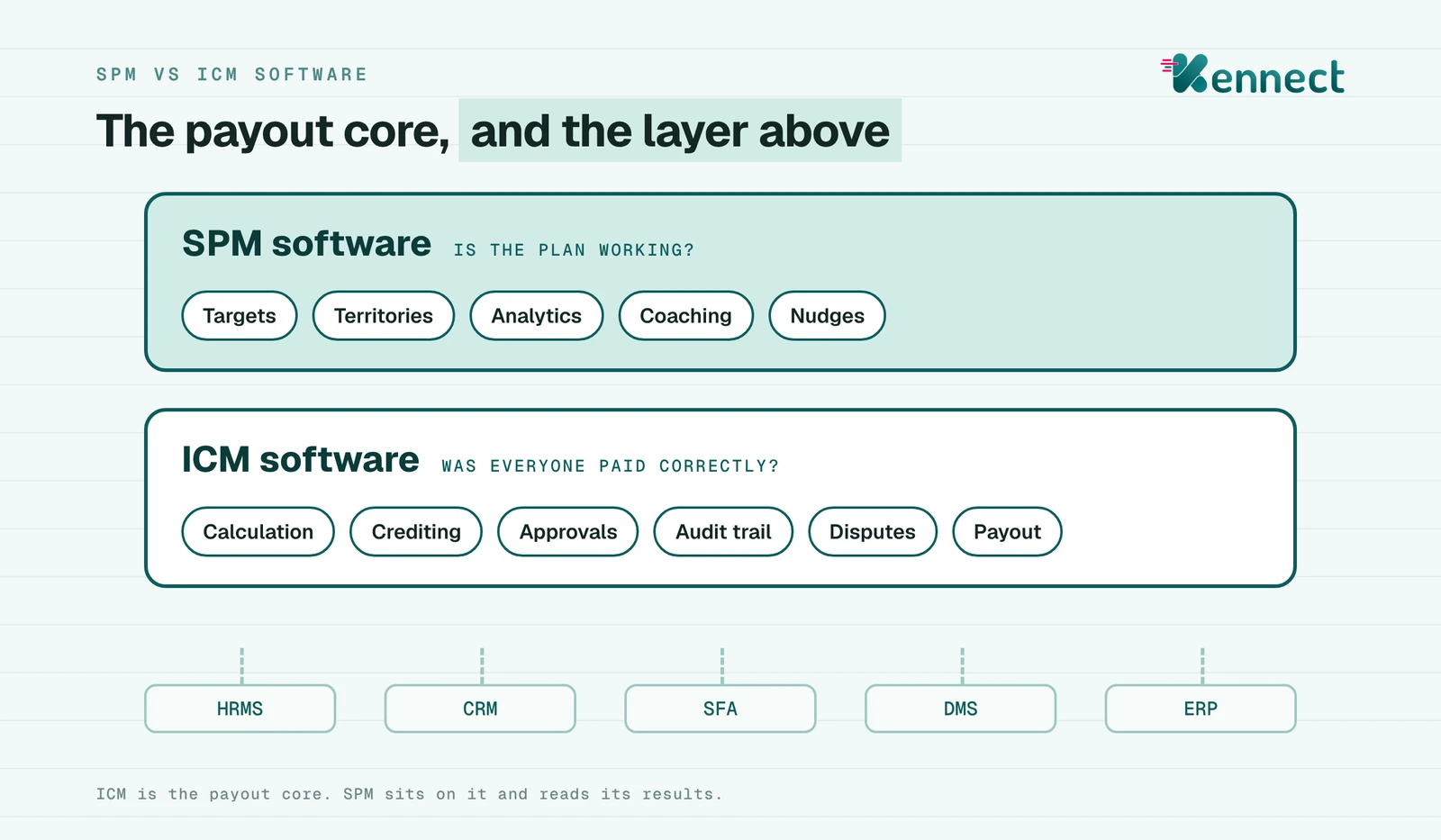
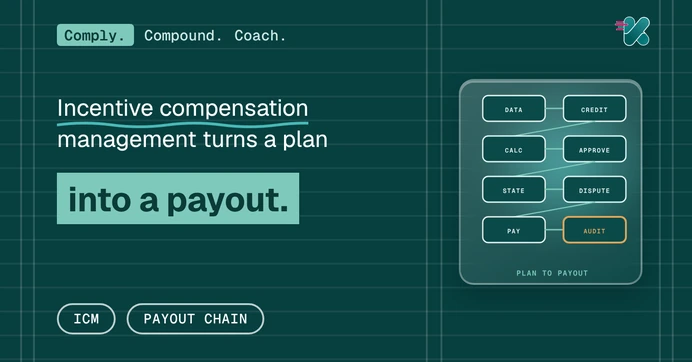
Incentive compensation management, or ICM, software answers one question. Was everyone paid correctly, and can we show it? It covers calculation, crediting, approvals, audit, disputes and payout.
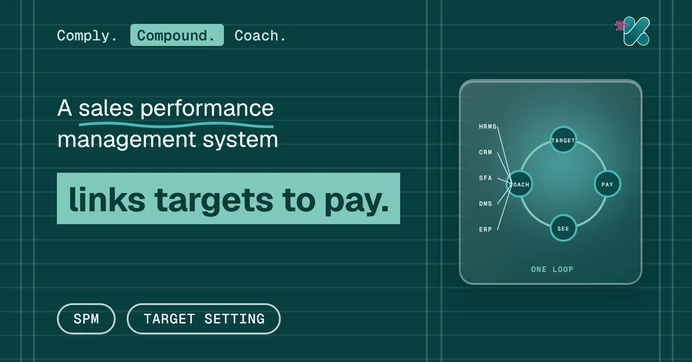
Sales performance management, or SPM, software asks a second question. Is the plan working, and can reps act on it? It adds targets, quotas, territories, analytics, coaching and nudges.
Gartner's 2026 research frames SPM the same way. SPM applications help sales operations leaders define territories and quotas. They also administer incentive plans that reward the right behaviors. In that framing, ICM is the core. SPM is the wider platform around it.
SPM vs ICM software: scope, owners and outputs
Area
ICM software
SPM software
Core question
Was everyone paid correctly?
Is the plan working?
Main owner
Finance, sales operations
CSO, CXO, sales operations
Key functions
Calculation, crediting, approvals, payout
Targets, territories, analytics, coaching
Audit and disputes
Audit trail, query handling
Inherits from ICM
Rep experience
Payout statement
Live cockpit, slabs, nudges
Main output
Correct, traceable payout
Better attainment next cycle
Typical data
HRMS, ERP, plan rules
CRM, SFA, DMS, ICM results
Without a sound ICM core, SPM shows reps numbers they doubt. An ICM tool alone pays correctly. It cannot tell leadership whether the plan moved sales.
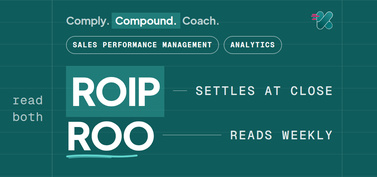
ICM proves the payout, and SPM tests the plan.
Which to buy first, by stage and industry
The answer depends on where errors and questions arise today. Four common situations follow.
Payouts run on spreadsheets. Buy the ICM core first. Fix calculation, crediting and audit before anything else. The usual steps sit in moving from Excel to incentive software.
Payouts are correct but late or disputed. Add rep visibility and query handling next. Reps who can see how each payout was built raise fewer questions.
Payouts are clean and leadership asks about return. Add the sales performance management (SPM) layer. Targets, territories, analytics and coaching now pay off.
A new plan, merger or new channel is coming. Buy both together on one data model. Two vendors means two versions of the truth.
Industry shifts the order too.
Pharma. Large field forces and secondary sales make the ICM core urgent. Visibility follows fast, because medical representatives work alone.
Banking and lending. Many products and cross-sell rules make crediting hard. Start with ICM, then add product-mix analytics.
Insurance. Agency and bancassurance channels pay on premium and persistency. Clawbacks need a clean ledger first.
FMCG. Distributor data arrives late. Start where the data is, often secondary sales, then add beat-level visibility.
The integration and data questions a CIO should ask
Both layers live or die on data. A CIO weighing sales performance management (SPM) vs ICM software can ask seven questions.
Which systems does it read from: HRMS, CRM, SFA, DMS and ERP?
Does it connect to SAP without custom code?
Does each payout trace to its plan, KPI and source record?
Are plans and targets held as dated versions?
Who can change a rule, and is each change logged?
Where is the data hosted, and how is access controlled?
Can a recompute run without breaking a closed period?
ICM is the payout core. SPM sits on it and reads its results.
The audit questions follow from Section 143(3)(i). Auditors test whether controls exist and work. For payouts, that means logged rule changes and approval trails. It also means traceable results. A spreadsheet rarely leaves that trail.
Every payout should trace to its plan, KPI and source.
Where AI changes each layer
AI does different work in each layer.
On the ICM side, AI explains and checks. It tells a rep why a payout came out as it did. It lets an admin trace a payout to the plan behind it. It drafts answers to payout queries. Fewer queries reach the incentive team.
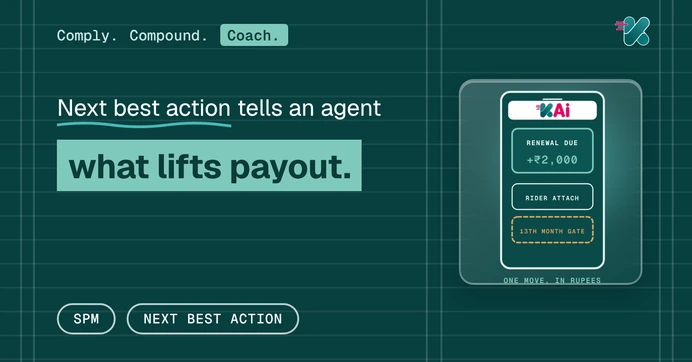
On the sales performance management (SPM) side, AI coaches. It summarizes a team's standing for each manager. It writes an earnings summary for each rep. Generative scenario modeling is expected January to March 2027. It will test a plan change before launch.
The governance need does not shrink with AI. Alexander Group's survey found fewer than 25% had fully built success measurement. AI helps where rules and data are already clean.
AI explains payouts in ICM and guides action in SPM.
How Kennect helps with both layers
Kennect is an AI-led sales performance and incentive compensation management platform. In the companies we work with, the ICM core usually comes first. So we built both layers on one data model.
Connectors. We read from the HRMS, CRM, SFA, DMS and SAP. Fill the white spaces, do not disrupt the foundation.
Kai, Kennect's AI: Kai explains each payout to the rep. Admins trace any payout to the plan and KPIs behind it. Tracing to source data follows by end of December 2026. Kai also helps resolve payout queries. For sales performance management (SPM), Kai writes coaching summaries. It writes earnings summaries for reps.
One mid-sized pharma deployment had 1,000+ medical representatives. Payout queries fell by 80%. That followed once reps could see how each payout was built. Close to payout fell to 5 days, from 2 to 3 months. The incentive team saved 200+ admin hours a month.
Source: Kennect claim register · mid-sized Indian pharma deployment, 1,000+ medical representatives · 80% fewer payout queries, close to payout in 5 days against 2 to 3 months, 200+ admin hours saved a month · reference build, 8 weeks from kickoff to first live payout
One data model lets the payout core and the performance layer agree.
What this means for the 2027-28 plan
The plan year starts on 1 April 2027. Software chosen in November can be live before then. A reference build reaches its first live payout in 8 weeks.
Start with the question that hurts today. If payouts are disputed, start with ICM. If payouts are clean, add sales performance management (SPM). See how to manage sales incentives for a sequence.
Choose by the decision you need to support in April.
ICM software answers whether everyone was paid correctly. It also shows proof. It covers calculation, crediting, approvals, audit, disputes and payout. SPM software adds targets, territories, analytics and coaching. It answers whether the plan is working. ICM is the core, and SPM is the wider layer on top.
Start with the payout core if payouts run on spreadsheets. The same holds if disputes are frequent. Pharma field forces are large, and secondary sales data is complex. Once payouts are traceable, add sales performance management (SPM). It brings targets, visibility and coaching. Buying both on one data model avoids two versions of the truth.
Ask which systems it reads from: HRMS, CRM, SFA, DMS and ERP. Ask whether it connects to SAP without custom code. Ask whether each payout traces to its plan, KPI and source record. Ask about dated plan versions, change logs, hosting and access control.
Section 143(3)(i) asks auditors to report on internal financial controls. They also report how well those controls operate. Incentive payouts are an expense in the financial statements. So controls over them can fall within that review. A logged rule change, an approval trail and a traceable payout help. Confirm scope with your auditor.
In incentive compensation management, AI explains why a payout came out as it did. It also helps resolve queries. Admins can trace a payout to its plan and KPIs. In sales performance management (SPM), AI writes coaching and earnings summaries. On Kennect, scenario modeling is expected January to March 2027.